

Pole Luminaires: The Complete Specification Guide for Park, Urban, and Pathway Lighting
Featured Products | September 24, 2026 | The Lighting Exchange
What you'll find in this article: how to pick the right optic and collection for your site, the real specs behind light source, finish, and dimming options, how these poles are actually built, and the answers to the five questions specifiers ask most.
Here's the thing about poles: nobody notices a good one. They notice a badly lit parking lot, a path that feels unsafe at night, or a plaza that floods the sky with wasted light. The pole and the optic behind it are what separate "considered" from "just bright."
Bullard Bollards runs three distinct pole collections — Garden/Park, Parking Lot/Urban, and Asymmetrical Pathway — covering everything from a quiet garden path to a full commercial lot. Here's how to actually spec the right one.
Start With the Optic, Not the Pole
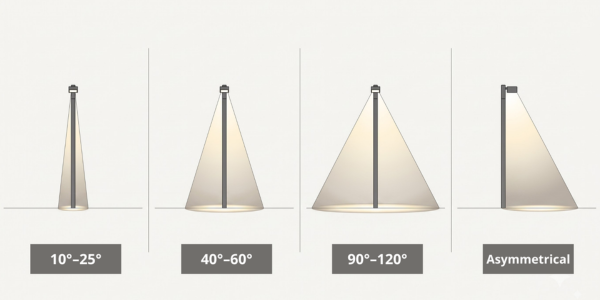
The optic decides where your light goes. Get this wrong, and you're either under-lighting the space or paying to illuminate the sky.
|
Beam Type |
Angle |
Best For |
|
Narrow |
10°–25° |
Accent lighting, tree uplighting, focal points |
|
Medium |
40°–60° |
General pathway and garden illumination |
|
Wide |
90°–120° |
Area lighting, open plazas, parking lots |
|
Asymmetrical |
Directed to one side |
Pathways where light should stay on the pedestrian zone |
That last one deserves its own explanation, because it's the one people get wrong most often.
Why Asymmetrical Optics Exist
A pathway doesn't need light in a full circle. It needs light on the walking surface — and nowhere else.
- The optic is shaped to throw light to one side of the fixture, not all around it.
- The pole sits to one side of the path, aimed across the walking surface.
- Less light spills into planting beds, upward into the sky, or into a neighbor's window.
- You need fewer fixtures to light the same stretch of path than you would with a symmetrical optic.
Symmetric vs. asymmetric, in one line: symmetric lights the area around the fixture equally; asymmetric puts the light where people actually walk.
Light Source
- High-efficiency LED throughout — 140–200 lm/W.
- CRI 80+ standard, CRI 90+ available where color rendering actually matters.
- CCT options: 2700K, 3000K, or 4000K, specified at order.
- 50,000+ hour rated life. No routine lamp replacement.
Finish Options
- Anthracite / RAL 7016 — the standard architectural choice for urban environments.
- Graphite / Black RAL 9005.
- Silver / Aluminium.
- Custom RAL colors on request — minimum quantities may apply.
- Hot-dip galvanized as a base layer for high-corrosion environments.
Dimming Options
|
Type |
What It Does |
|
1-10V |
Simple analog dimming, compatible with most control systems |
|
DALI |
Digital addressable control, smart city and building management integration |
|
PWM |
Pulse width modulation for flicker-free dimming at low output |
|
Non-dimmable |
For applications where simplicity is the priority |
Installation and Dimensions
- Direct burial — pole base set in a concrete foundation.
- Surface mount — anchor bolt pattern to an existing slab.
- Hinged base — lowers the pole for maintenance in high-access environments.
- Heights: 3m / 4m / 5m / 6m / 8m / 10m, depending on collection and application.
- Pole diameter: 60mm–168mm, depending on height and wind load.
- Outreach arms available in single, double, and decorative configurations.
How They're Made
Every pole starts as raw steel or aluminum tube. Not a pre-built part.
- Tube forming: steel or aluminum tube is rolled or extruded to the pole's diameter and wall thickness.
- Base plate welding: a base plate is welded to the shaft and drilled to match the foundation's anchor bolt pattern.
- Access door: a hand-hole with a lockable cover is cut into the base for wiring access and a terminal block.
- Wall thickness engineering: calculated against the pole's height, luminaire load, and local wind requirements.
- Finishing: hot-dip galvanizing, powder coat, or both — applied based on the corrosion environment the pole will actually sit in.
Core Features
- Single-piece shaft. No visible seams or joints along the pole's length.
- Internal wireway. Cabling runs inside the pole, not exposed on the surface.
- Grounding lug. Bonded to the base plate for electrical safety compliance.
- Handhole cover. Flush-fitting and gasketed, keeping moisture out of the wiring compartment.
-
Anchor bolt compatibility. Base plates are drilled to standard bolt circle patterns — poles can be swapped without re-pouring a foundation.
Materials
- Aluminum — the standard shaft and housing material. Lightweight, naturally corrosion-resistant, easily powder-coated.
- Stainless steel — used for hardware, fasteners, and select housings where maximum corrosion resistance is required.
- Steel — used for taller, higher-load poles, typically hot-dip galvanized as a base protective layer.
-
Hot-dip galvanized steel — the base treatment for high-corrosion or coastal environments, often paired with a powder coat topcoat.
Where These Actually Get Installed
- Garden and park pathways — lower poles, closer spacing, softer light levels.
- Residential and mixed-use streets — moderate heights, pedestrian-scaled spacing.
- Urban plazas and civic spaces — taller poles, wider optics, higher output.
- Parking lots and commercial lots — the tallest poles in the range, wide-angle optics for area coverage.
- Campus and institutional grounds — a mix of the above within one coordinated pole family.
Bullard Bollards' specification team can help you match collection, height, optic, and finish to your actual site conditions — not just pick the tallest pole in the catalog.
FAQs
- How do I choose the right pole height? A general rule: mounting height should be roughly equal to the pole spacing divided by 3 to 4. A 6m pole typically covers 18–24m of spacing in pathway applications. Urban and parking applications need actual photometric calculations for the specific luminaire and layout — don't eyeball this one.
- What's the difference between symmetric and asymmetric optics? Symmetric optics spread light equally in all directions below the fixture — good for area lighting and open plazas. Asymmetric optics throw light predominantly to one side, ideal for pathways where you want light on the walking surface, not in the surrounding vegetation or up into the sky.
- Can poles be specified with smart controls? Yes. DALI-compatible luminaires integrate with smart city management systems for remote dimming, scheduling, and fault monitoring. Motion sensor accessories are also available on select models.
- What finish holds up best in coastal environments? Hot-dip galvanized steel as a base, with marine-grade powder coat on top, is the most durable combination for salt-air exposure. Stainless steel pole options are available for the most demanding coastal applications.
- Are custom heights and configurations available? Yes, through the Bespoke programme. Non-standard heights, custom arm configurations, and decorative profiles are all available — contact the specification team with your project requirements.
Other News Content by:
Bullard Outdoor
Understanding Dark Sky Lighting — And Why It Matters
Featured Products | August 18, 2026 | The Lighting ExchangeSymmetrical vs. Asymmetrical Lighting — Choosing the Right Distribution for Your Project
Featured Products | July 10, 2026 | The Lighting Exchange