


Understanding Dark Sky Lighting — And Why It Matters
Featured Products | August 18, 2026 | The Lighting Exchange
Dark Sky: Lighting that does its job without polluting the sky above it.
There's a version of good lighting design that's been quietly accepted for decades — bright, wide, covering every surface in every direction. The assumption was that more light meant more safety, more visibility, more security. What it actually meant, in many cases, was wasted energy, glare, and a sky that's no longer dark anywhere near a populated area.
Dark Sky lighting exists to correct that. And increasingly, it's not just a design preference — it's a code requirement, a planning condition, and a standard that projects are being evaluated against before they're approved.
What Dark Sky Actually Means
The International Dark-Sky Association (IDA) defines light pollution as the inappropriate or excessive use of artificial light. Dark Sky compliance is about controlling where light goes — directing it downward onto the surfaces that need it, and preventing it from scattering upward into the sky or sideways into areas it doesn't serve.
A Dark Sky compliant fixture:
- Directs light downward — full cutoff or shielded optics that prevent upward light emission
- Uses appropriate color temperature — warm white light, typically 3000K or below, which scatters less in the atmosphere and has less impact on nocturnal wildlife
- Delivers the right amount of light — not the maximum amount, but the amount the application actually requires
- Minimizes glare — which improves visibility for the people in the space as much as it reduces impact on the surrounding environment
Why It Matters Beyond Regulation
Light pollution has measurable consequences that go beyond the loss of visible stars. Artificial light at night disrupts circadian rhythms in humans and animals, affects migratory bird patterns, impacts insect populations, and alters the behavior of nocturnal species that entire ecosystems depend on.
For urban environments, there's a more immediate concern: sky glow. The diffuse orange haze visible above any city at night is the accumulated upward scatter of thousands of poorly directed light sources. It reduces visibility for everyone in the area, wastes a significant portion of the energy consumed by those fixtures, and contributes nothing to the safety or function of the spaces below.
Dark Sky design doesn't sacrifice safety or visibility. A well-specified downward-directed fixture often improves visibility at ground level by reducing glare and delivering light where eyes actually need it.
The Practical Implications for Specifiers
A few things that shape the specification:
- Fixture shielding — full cutoff classification means zero light emitted above the horizontal plane. This is the baseline for most Dark Sky compliant specs and is now standard in many commercial and municipal applications
- Color temperature — 2700K to 3000K is the accepted range for most Dark Sky applications. Higher color temperatures (4000K and above) scatter more in the atmosphere and are increasingly restricted in sensitive areas
- Adaptive controls — dimming and motion-responsive systems reduce output during low-occupancy periods, which supports Dark Sky goals while directly extending the life of the system and reducing energy consumption
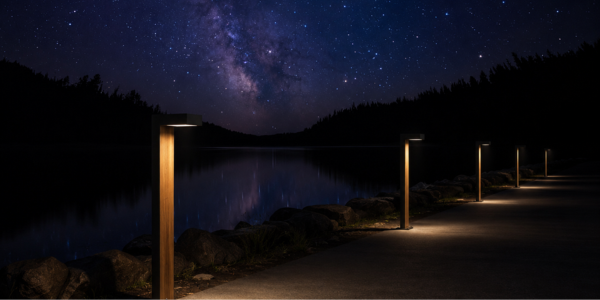
- Bollard lighting — low-mounted bollards are inherently well-suited to Dark Sky compliance. Light directed downward from a low source illuminates pathways and ground planes efficiently with minimal upward scatter, making them one of the most effective tools in a Dark Sky compliant exterior lighting scheme
Where This Is Heading
Dark Sky ordinances are expanding. California, Florida, and a growing number of municipalities have adopted or are in the process of adopting outdoor lighting codes that restrict color temperature, require full cutoff fixtures, and in some cases limit total lumen output per site area.
Good lighting has always been about putting light where it's needed. Dark Sky compliance formalizes that principle and extends it to the broader environment. The night sky, the ecosystems around a site, and the people using the space after dark all benefit from lighting that's directed, appropriate, and controlled.
Other News Content by:
Bullard Outdoor
Pole Luminaires: The Complete Specification Guide for Park, Urban, and Pathway Lighting
Featured Products | September 24, 2026 | The Lighting ExchangeSymmetrical vs. Asymmetrical Lighting — Choosing the Right Distribution for Your Project
Featured Products | July 10, 2026 | The Lighting Exchange