


Beam Angle Explained: Why 20°, 40°, and 60° Matter When Specifying Accent Lighting
Design Tips & Techniques | September 24, 2026 | The Lighting Exchange
Beam angle is too often treated as a minor spec sheet detail, when in practice it is the single number most responsible for whether accent lighting highlights one object with intent or simply washes an entire wall by accident.
What you'll find in this article: what beam angle actually measures, how 20°, 40°, and 60° beams behave differently in real spaces, and what to weigh when specifying beam angle for accent lighting.
Take two fixtures with identical lumen output, install them side by side, and the results on the wall can look entirely unrelated — because one carries a 20° beam and the other a 60°. Lumens describe how much light a fixture produces. Beam angle describes where that light actually goes, and the distinction matters more than most specifications acknowledge.
What beam angle actually measures
Beam angle refers to the width of the cone of light leaving a fixture, expressed in degrees.
- A narrower angle concentrates the same lumen output into a smaller area, producing a brighter, more intense result at the target surface
- A wider angle distributes those same lumens across a larger area, reducing intensity per square foot as it spreads
- Two fixtures with identical lumen output can therefore produce dramatically different visual effects, depending entirely on beam angle
20°: narrow spot for precision accents
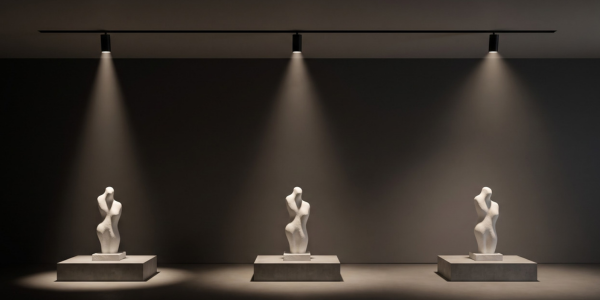
A 20° beam functions as a true spotlight, engineered to draw attention to one specific object.
- Well suited to artwork, sculptural pieces, or architectural features intended to stand apart from their surroundings
- Produces strong contrast between the illuminated subject and the space around it
- Too concentrated for general room lighting, since it leaves the surrounding area visibly underlit
40°: medium spread for general accent work
A 40° beam occupies the flexible middle ground between a tight spot and a broad wash.
- Appropriate for task areas and moderately sized features, from a console table to a display shelf to a kitchen counter
- Wide enough to cover a modest zone evenly without spilling far beyond its intended boundary
- Often the safer default when a feature's exact dimensions haven't yet been finalized
60° and wider: wide flood for ambient fill
A 60° beam behaves less like a spotlight and more like a wash, softening contrast rather than creating it.
- Effective across large surfaces — full walls, ceilings, or broad architectural and landscape washes
- Layers well alongside narrower beams elsewhere in the same space to build visual depth
- The wider the angle grows, the less dramatic the resulting highlight becomes, which makes it well suited to filling shadow rather than establishing a focal point
What a specifier should weigh
- Begin with the feature's actual size, then adjust lumen output afterward to achieve the intended brightness at the target
- Ceiling height changes the underlying math — a narrow beam from a high ceiling covers considerably more area than the same beam from a low one
- Consider layering angles across a space rather than selecting a single beam angle for an entire room, reserving narrow beams for focal points and wider beams for fill
Beam angle deserves more attention on a specification sheet than it typically receives, since it is arguably the one figure most responsible for whether a finished space reads the way its designer intended.
FAQ
Is a narrower beam angle always brighter? At the target surface, yes — concentrating the same lumens into a smaller area increases intensity there, even though the fixture's total light output hasn't changed.
What beam angle works best for artwork? A narrow beam in the 15°–25° range typically provides the strongest contrast for highlighting a specific piece against its surroundings.
Is it acceptable to use a single beam angle throughout a room? It's possible, but most well-considered designs layer multiple angles — narrow for focal accents, wider for ambient fill — rather than relying on one beam angle for an entire space.
How does ceiling height factor into beam angle selection? A higher ceiling spreads a given beam angle over a larger area at the target surface, meaning the same fixture will behave differently depending on mounting height.
Are beam angle and brightness the same specification? No — beam angle governs where light travels, while lumen output governs how much light exists overall; the two work in tandem but are not interchangeable.
Other News Content by:
BYIBA
Magnetic Track Lighting: The System That Moves When Your Design Does
Featured Products | August 18, 2026 | The Lighting ExchangeAcoustic Pendants: Lighting That Also Brings Comfort to a Room
Featured Products | July 10, 2026 | The Lighting Exchange