

Alabaster Lighting: When Stone Learns to Glow
Design Tips & Techniques | August 18, 2026 | The Lighting Exchange
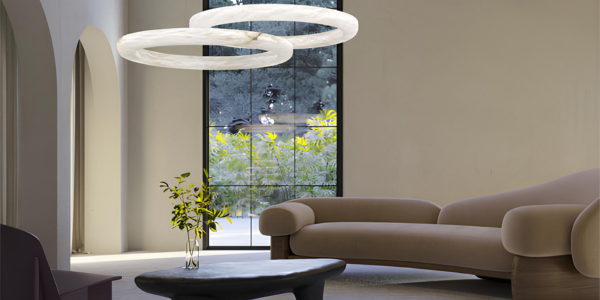
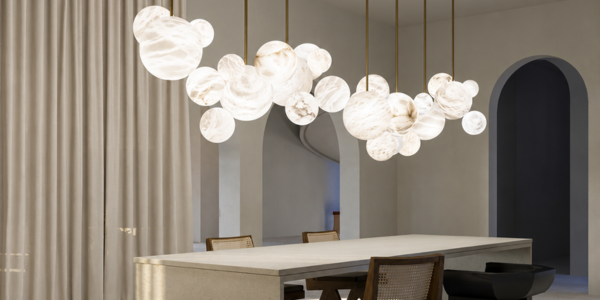
Alabaster lighting is the rare fixture that's beautiful switched off — and becomes something else entirely once you turn it on.
What you'll find in this article: why alabaster glows instead of just diffusing light, what to consider before specifying it, and where alabaster pendants and sconces work best.
Most materials in a room either reflect light or block it. Alabaster does neither — it drinks light in and lets it back out, slower and softer, like the stone itself is holding onto the glow for a moment before releasing it. That's not a design trick. It's physics, carved by hand.
What alabaster actually is
Alabaster is a natural, fine-grained stone with a micro-crystalline structure. Instead of letting light pass straight through, as glass does, light entering alabaster scatters between those microscopic crystals before exiting across a broad surface.
- Erases glare instead of just softening it
- Produces a warm, even wash instead of a visible bulb
- Reads as glowing stone, not a lit fixture
Why it matters for a room
No two pieces are alike — every slab carries its own veining and color drift, so a fixture becomes less like a manufactured object and more like a found one.
- Thin sections (roughly 1/8–1/4 inch) glow brightly and show veining clearly
- Thicker sections stay softer and more diffused
- Thinness is the whole craft: too thin and the stone is fragile, too thick and it stops glowing
What a specifier should weigh
- Sealing: alabaster is porous and will absorb oils and moisture and stain permanently without a proper wax, oil, or acrylic seal
- Heat source: pair with low-heat LEDs — alabaster's charm is soft diffusion, not raw brightness, and excess heat can stress the stone over time
-
Cost: expect a premium versus composite or resin alternatives — that buys hand-selected stone and hand-finished thinness, not a shortcut
Where it belongs
- Dining rooms and living spaces where mood matters more than lumens
- Boutique hotel lobbies and suites going for quiet luxury over spectacle
- Sconces and pendants meant to be the room's one unmistakable object
A light fixture usually disappears once it's on. Alabaster is one of the rare materials that gets more interesting the moment you flip the switch.
FAQ
Is alabaster the same as marble or quartz? No — it's a distinct, softer natural stone. It shares a family resemblance with other translucent stones used in lighting, but its lower density is exactly what gives it that signature glow.
Does alabaster need special care? Dust it with a soft, dry cloth and avoid harsh chemicals or excess moisture. A barely damp cloth, dried immediately, is fine if needed.
Will every piece look the same? No, and that's the point. Natural veining and color variation mean each fixture is genuinely one of a kind.
Is alabaster fragile? It's more durable than its delicate look suggests, but it is porous and should stay sealed and away from harsh cleaners.
Does it work in smaller residential spaces, or only large installations? Both — a single alabaster sconce or table lamp can anchor a small room just as effectively as a chandelier anchors a lobby.
Other News Content by:
Lola Lighting
Alabaster vs. Concrete vs. Ceramic: Comparing Lola's Stone & Mineral Materials
Featured Products | September 24, 2026 | The Lighting ExchangeSilk — The Six Years Behind the Light
Design Tips & Techniques | July 10, 2026 | The Lighting Exchange