
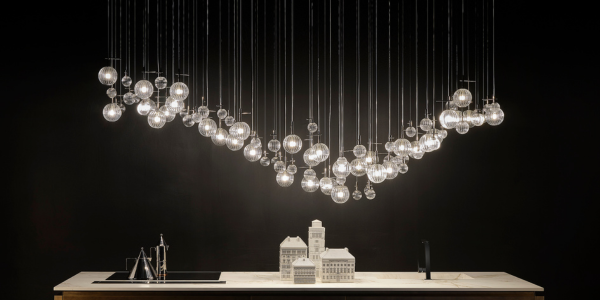

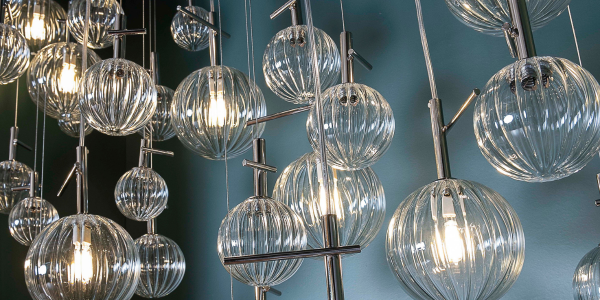
The Globe Collection: Murano Glass, Shaped by Breath
Featured Products | August 18, 2026 | The Lighting Exchange
No two Murano glass globe pendants in this collection are identical — and that's not a limitation of hand-blown glass, it's the entire point of it.
What you'll find in this article: what makes hand-blown glass different, why the globe shape diffuses light so evenly, and what to weigh when specifying Cerchio's Globe Collection.
There's a specific kind of quiet that settles over a room lit by a single glowing sphere. Not the sharp pool of a downlight, not the scatter of a chandelier — something rounder, calmer, closer to candlelight than to electricity. Murano glass has been chasing that effect for seven hundred years.
What makes it Murano glass, specifically
Murano glass is mouth-blown, by hand, on the island of Murano near Venice — a technique passed down through generations of glassmakers rather than written into a manual. Molten glass is shaped by breath and gravity rather than a mold.
- Every sphere carries small variations in thickness, bubble, and curve
- Those variations aren't flaws to engineer out — they're what separates hand-blown glass from cast or pressed glass
- No two globes come out of the furnace exactly alike
Why the globe shape specifically
A sphere has no hard edges to catch or scatter light unevenly — it diffuses in every direction at once, which is why globe pendants read as soft and ambient rather than directional.
- Sommerso: layers colored glass within clear glass for depth
- Filigrana: twists threads of colored glass into fine, lace-like patterns
- Both add pattern without changing the fundamental, even glow
What a specifier should weigh
- Variation: each globe is hand-blown, so expect natural differences in size and tone between pieces on multi-fixture projects
- Weight and hardware: confirm mounting hardware early, since glass thickness varies piece to piece
-
Provenance: authentic Murano glass typically comes with a certificate of origin — worth requesting when provenance matters to the client
Where it belongs
- Entryways and stairwells where one glowing form should anchor the space
- Dining and lounge settings clustered in multiples for a warmer, layered look
- Hospitality projects where a handmade object signals real craftsmanship, not decoration
A globe pendant doesn't try to disappear into the ceiling. It wants to be looked at — and in a room full of straight lines and flat light, that's usually exactly what's missing.
FAQ
Is Murano glass the same as any glass made in Italy? No — true Murano glass is made on the island of Murano near Venice, using techniques specific to that region's glassmaking tradition.
Why do prices vary so much between globe pendants? Hand-blown glass takes longer to produce and involves more skilled labor than molded or pressed glass, and complex techniques like sommerso or filigrana add further time and cost.
Will my globes match exactly if I order several? They'll be close in form and color family, but expect natural variation — that's inherent to hand-blown glass, not a manufacturing inconsistency.
Does Murano glass work with LED sources? Yes, and LEDs' low heat output is kinder to the glass and any metal fittings over time than older, hotter sources.
Is this collection suited to smaller residential rooms, or only large commercial spaces? Both — a single globe pendant works as well over a small dining table as a cluster does in a hotel lobby.
Other News Content by:
Cerchio Lighting
The Biophilic Case for Botanical Lighting: What Living Plants Actually Do to a Room
Codes & Compliance | September 25, 2026 | The Lighting ExchangeCrystal Pendants: Where Engineering Meets Light
Featured Products | July 10, 2026 | The Lighting Exchange