

Solar Security Bollards — A Smarter Way to Protect a Site
Featured Products | July 10, 2026 | The Lighting Exchange
When perimeter security meets off-grid power, the result is more resilient than either alone.
Security bollards are a permanent fixture on a site — embedded in concrete, engineered to stop vehicles, and expected to perform for decades. When those bollards also need to be illuminated, the question of how to power them is worth thinking through carefully.
Grid power is the default answer. It's familiar and reliable, but it comes with infrastructure requirements that aren't always straightforward — particularly when the security perimeter doesn't follow the path of existing electrical conduit. Solar changes that calculation in ways that go beyond cost.
What Solar-Powered Security Bollards Actually Are
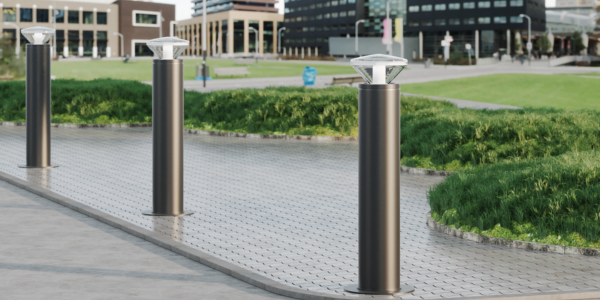
A solar-powered illuminated security bollard combines two functions in one unit: physical vehicle deterrence, crash-rated to a specific standard, and integrated solar lighting powered by an onboard panel and battery system.
During daylight hours, the solar panel charges the battery. At night, the bollard illuminates from stored energy — no grid connection required. In hybrid configurations, a grid backup maintains output through extended periods of low solar input.
The physical security function is entirely independent of the power source. Solar doesn't change what the bollard can stop. It changes how it's powered.
Why Solar Security Bollards
Running conduit to a bollard line across a plaza, hardscaped pedestrian zone, or protected landscape adds cost that has nothing to do with the security system itself. Solar-powered bollards address this directly — each unit is self-contained:
- No conduit runs across finished hardscape or landscape
- No connection to the building's electrical system
- No utility coordination or additional electrical permits
- Simplified installation with a smaller overall project footprint
On large or complex sites, that's a meaningful difference in both budget and timeline.
The Resilience Argument
A grid-tied illuminated bollard goes dark in a power outage. In a security context, that's a real vulnerability — the physical barrier stays in place, but visual deterrence and site illumination disappear at exactly the moment conditions may be most unpredictable.
A solar bollard with battery storage operates independently of the grid. That resilience matters most at:
- Federal and government facilities
- Hospitals and emergency services campuses
- Transit hubs and transportation infrastructure
- Stadiums and large public assembly venues
The perimeter stays illuminated. A power outage elsewhere on the block doesn't change that.
Where It Works Best
- Open sky exposure above the bollard line with minimal shading
- Perimeters that extend away from existing electrical infrastructure
- Sites with sufficient sun hours for the required output and hours of operation
Sites with heavy shading or significant seasonal sun variation may be better suited to a hybrid configuration — solar primary, grid backup — rather than pure off-grid solar.
What To Bring Into The Specification Early
These questions are easier to answer before electrical drawings are finalized:
- Sun hours for the project location across seasons
- Whether the bollard line is shaded or open
- Required illumination level and nightly hours of operation
- Whether pure solar or hybrid is the right fit
- Foundation type — deep standard or shallow
Security and solar are no longer separate conversations on a site. When the specification accounts for both from the start, the result is a perimeter that's harder to compromise — physically and operationally.
Other News Content by:
Bullard Bollards
Die-Cast vs. Extruded Aluminum: Choosing the Right Alloy for Outdoor Fixtures
Design Tips & Techniques | September 24, 2026 | The Lighting ExchangeSymmetrical vs. Asymmetrical Lighting — Choosing the Right Distribution for Your Project
Design Tips & Techniques | August 18, 2026 | The Lighting ExchangeSecurity Bollards: Life-Saving Architectural Infrastructure
Featured Products | June 03, 2026 | The Lighting Exchange